Alberta GP Billing Software
— What to Look for in 2026 (and What to Avoid)
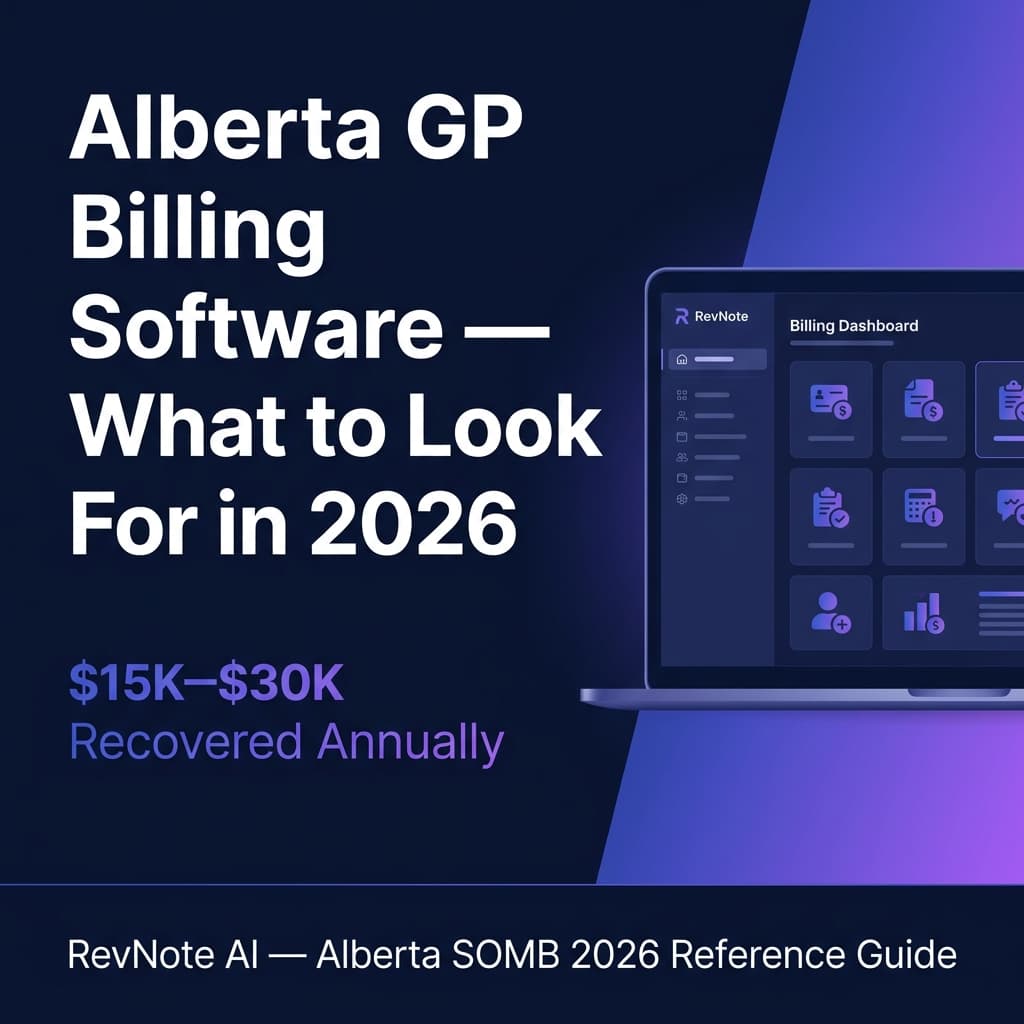
Alberta family physicians lose an average of $15,000 annually to billing errors, missed codes, and documentation gaps—money that could be recovered with the right billing software. With 40% of claims rejected due to inadequate documentation and each encounter consuming precious minutes on administrative tasks, choosing the right GP billing software in 2026 isn't just about convenience—it's about protecting your practice revenue. This comprehensive comparison breaks down the features, costs, and revenue impact of today's leading Alberta GP billing solutions.
What Alberta GPs Need in Billing Software: Beyond Basic Claims Submission
The landscape of Alberta GP billing software has evolved dramatically since 2024. Modern solutions must do more than simply submit claims to Alberta Health Care Insurance Plan (AHCIP)—they need to actively prevent revenue leakage through intelligent code suggestion, real-time eligibility verification, and comprehensive documentation support. The difference between basic and advanced billing software can mean $15,000 or more in annual revenue for a typical full-time family practice.
When evaluating billing software in 2026, Alberta GPs should prioritize three critical capabilities: automated code capture that identifies billable services you might otherwise miss, documentation templates that satisfy AHCIP audit requirements, and real-time claim validation that catches errors before submission. The best systems integrate directly with your EMR, learning your practice patterns and suggesting appropriate codes based on your clinical notes. For instance, if you document a 45-minute visit addressing multiple chronic conditions, the software should automatically flag opportunities for complex care codes beyond the basic visit fee.
The financial stakes are substantial. Consider that 40% of claim rejections stem from documentation gaps—issues that could be prevented with proper software safeguards. When you factor in the administrative time required to identify, correct, and resubmit rejected claims, plus the codes you never billed because you didn't realize they applied, the cost of inadequate billing software quickly exceeds any savings from choosing a budget option. Forward-thinking practices are now viewing billing software as a revenue optimization tool rather than merely an administrative expense.
Key Billing Codes Every Software Should Handle Seamlessly
Applies to standard consultations and assessments in the office setting for established or new patients requiring straightforward evaluation and management. This is your baseline visit code for routine appointments.
No specific billing limits, but cannot be billed with other comprehensive assessment codes for the same encounter date.
Chart must document chief complaint, relevant history, examination findings, assessment, and plan appropriate to the clinical complexity.
For encounters involving significant complexity due to multiple diagnoses, psychosocial factors, or extensive management decisions. Typically applies when managing three or more active problems or when visit extends beyond 30 minutes due to complexity.
Should not be billed routinely for every patient; AHCIP audits specifically review frequency of complex codes relative to standard visits.
Must document multiple distinct problems addressed, complexity factors justifying the higher code, and time spent if duration is a factor in code selection.
Premium added to visit codes when encounter exceeds standard time due to counseling, coordination of care, or complex decision-making. Typically applies to visits lasting 45+ minutes with majority of time in discussion.
Must be billed in conjunction with a base visit code; cannot be used alone and time must be clearly documented.
Chart must specify total visit duration and describe nature of extended time (counseling topics, care coordination activities, or complexity requiring additional time).
For virtual care encounters conducted via phone or video where a complete assessment is performed. Applies to both established and new patients when clinical assessment can be appropriately conducted remotely.
Subject to same billing rules as in-person visits regarding complexity coding and time-based premiums.
Must document modality used (phone/video), consent for virtual care, clinical findings obtained remotely, and rationale for appropriateness of virtual assessment.
For focused encounters dedicated to management of established chronic conditions such as diabetes, hypertension, COPD, or heart failure where the visit is primarily disease monitoring and treatment adjustment.
Intended for disease-specific management visits; should not be billed when chronic disease is incidentally addressed during acute problem visit.
Chart must identify the specific chronic condition being managed, relevant monitoring parameters reviewed, and management adjustments made during the encounter.
Common Documentation Mistakes That Trigger Claim Denials
Many GPs bill 03.03J for extended encounters but fail to document the specific factors justifying complexity—such as listing the three or more distinct problems addressed or describing the medical decision-making complexity. Your billing software should prompt you to document these elements when selecting complex codes. The correct approach is to explicitly list each problem addressed with its own assessment and plan, and note any psychosocial factors or coordination challenges that contributed to complexity.
When billing extended visit premiums like 03.04J, GPs often document that the visit was 'lengthy' without recording the actual start and end times or total duration. AHCIP auditors specifically look for precise time documentation—not estimates—when reviewing premium claims. Your software should have a time-tracking feature or mandatory field that captures exact visit duration when extended codes are selected, ensuring you can defend the billing during any audit.
With telehealth codes like 03.01A now standard, many claims are rejected because charts don't explicitly document patient consent for virtual care or specify whether phone or video was used. Modern billing software should auto-populate telehealth templates that include consent confirmation and modality fields. Always document 'Patient consented to phone/video assessment' and 'Clinical assessment appropriately conducted via [modality]' to satisfy audit requirements.
When billing 03.05A for chronic disease management, GPs sometimes document a general 'follow-up' without clearly identifying which chronic condition was the focus of the encounter. Your billing software should link chronic disease codes to specific ICD codes and prompt you to document disease-specific parameters. The correct approach is to title your note with the condition (e.g., 'Diabetes Management Visit') and document relevant metrics like HbA1c, medication adjustments, and monitoring plan.
A frequent error is billing both a comprehensive visit code and a separate procedure or counseling code that should have been bundled into the visit fee. AHCIP's co-billing rules are complex, and manual billing makes it easy to submit incompatible combinations. Advanced billing software includes real-time validation that flags incompatible code combinations before claim submission, preventing automatic rejections. If your software lacks this feature, you're likely losing revenue to rejected claims and spending unnecessary time on resubmissions.
Real Example: Maximum Revenue Scenario with Proper Software
A 68-year-old patient with diabetes, hypertension, and depression presents for a comprehensive chronic disease management visit. The encounter takes 50 minutes, addressing medication adjustments for all three conditions, reviewing recent lab results, and providing counseling on lifestyle modifications.
Frequently Asked Questions
What's the difference between cloud-based and installed billing software for Alberta GPs in 2026?
Cloud-based solutions offer automatic updates to Alberta's fee schedule (which changes annually), real-time claim submission, and access from any location—critical for GPs doing telehealth or working from multiple clinics. Installed software requires manual updates and IT support but may offer more customization. Given that code fees like 03.03A ($41.97) and 03.03J ($78.65) change periodically, cloud solutions ensure you're always billing current rates without manual intervention. Most leading Alberta GP billing platforms in 2026 are cloud-based with bank-level security meeting Canadian privacy requirements.
Can billing software really identify missed codes, or is that just marketing?
Advanced AI-powered systems genuinely can identify missed billing opportunities by analyzing your clinical documentation. For example, if your note describes a 45-minute visit addressing diabetes, hypertension, and depression management, intelligent software will flag that you could bill 03.03J ($78.65) plus 03.04J ($35.86) for total of $114.51, rather than defaulting to basic 03.03A ($41.97). The $15,000 average annual recovery reflects these incremental opportunities across hundreds of encounters. However, basic billing software that only submits codes you manually select cannot identify these opportunities—the AI component is what differentiates revenue recovery systems from simple claim submission tools.
How do I know if my current billing software is costing me money?
Run this simple test: review your last 50 claims and calculate what percentage were standard visit codes (03.03A at $41.97) versus complex codes (03.03J at $78.65) or included extended premiums (03.04J at $35.86). If more than 80% of your visits are billed as standard codes, you're likely missing significant revenue—typical family practices should have 25-40% of encounters qualifying for higher codes. Also check your claim rejection rate; if it exceeds 5%, inadequate documentation support from your software is costing you both revenue and administrative time. Finally, if your software doesn't suggest codes based on your clinical documentation, you're doing manual work that could be automated, losing the 10 minutes per encounter that AI coding saves.
What integration capabilities should I look for when comparing Alberta GP billing software?
Prioritize seamless EMR integration that reads your clinical notes and suggests appropriate codes without requiring duplicate data entry. The software should integrate with major EMRs used in Alberta (like Accuro, OSCAR, and Telus PSS) to pull patient demographics, visit details, and clinical documentation. Look for systems that automatically update when AHCIP releases fee schedule changes, integrate with NetCare for lab results that inform billing decisions, and connect with provincial registries for patient eligibility verification. Integration reduces the risk of billing telehealth code 03.01A ($41.97) for an in-person visit or missing chronic disease management code 03.05A ($58.32) because the software didn't recognize documented diabetes follow-up.
Are AI-powered billing systems worth the higher cost compared to basic billing software?
The math is straightforward: if AI billing software costs $200-400 monthly but recovers an average of $15,000 annually ($1,250/month), the ROI is 3-6x the investment. Consider a single properly captured complex visit with extended premium (03.03J at $78.65 plus 03.04J at $35.86 totaling $114.51) versus a basic visit (03.03A at $41.97)—that's $72.54 additional revenue per encounter. If AI helps you properly code just 17 encounters monthly, you've recovered the software cost. Factor in time savings of 10 minutes per encounter (worth $50-70 in physician time), reduced claim rejections from the current 40% rate, and audit protection from proper documentation prompts, and AI-powered systems deliver clear financial benefit for any GP seeing 20+ patients daily.
Related Billing Guides
Stop Leaving Money on the Table with Every Patient Encounter
RevNote AI's billing intelligence learns from your clinical documentation to suggest optimal codes, ensures AHCIP-compliant documentation, and catches errors before submission—recovering an average of $15,000 annually while saving you 10 minutes per encounter. Alberta GPs can try RevNote AI's complete billing optimization free for 10 encounters to see exactly how much revenue your current system is missing. No credit card required.
No credit card. Works in 60 seconds.