Alberta Medical Billing Course Options 2026: Training for Clinic Staff
Alberta family physicians leave an average of $40,000 to $60,000 on the table annually due to billing errors, missed codes, and incomplete documentation. Whether you're a new graduate navigating your first SOMB submissions or an experienced GP looking to optimize revenue, understanding Alberta's medical billing framework is critical to your practice's financial health. The complexity of the Alberta Schedule of Medical Benefits—with over 3,000 billing codes and frequent updates—makes formal billing education not just valuable, but essential.
Why Alberta Medical Billing Training Is Essential for Family Physicians
Medical school provides excellent clinical training but virtually no instruction on the business side of practice—specifically, how to accurately bill for the care you provide. Alberta's fee-for-service model means your income directly depends on your billing accuracy and completeness. A comprehensive Alberta medical billing course teaches you to identify all billable services within an encounter, apply the correct SOMB codes, understand complex rules around service combinations, and document appropriately to withstand Alberta Health audits.
The stakes are significant. Consider that a typical family practice sees 25-30 patients daily. If you under-bill by just $15 per encounter due to missed codes or documentation gaps, that's $375 daily or approximately $90,000 annually in lost revenue. Conversely, incorrect billing practices can trigger audits and repayment demands. Quality billing education protects you from both under-billing and over-billing risks.
Effective billing courses for Alberta physicians cover the SOMB structure, common GP codes (visits, procedures, preventive care), time-based billing, complex visit premiums, chronic disease management codes, telehealth billing, documentation standards, audit preparedness, and claim submission processes. The best courses provide real clinical scenarios, practice exercises, and ongoing updates as Alberta Health modifies billing rules—which happens multiple times per year.
Core Billing Codes Every Alberta GP Should Master
Applies to comprehensive office consultations for patients with complex or multiple problems requiring detailed assessment. Typically used for new patient assessments, annual health exams, or established patients with multiple active conditions requiring comprehensive review.
Cannot be billed with same-day minor assessment codes. Maximum one comprehensive visit per patient per day unless exceptional circumstances are documented.
Chart must detail comprehensive history, thorough physical examination findings, assessment of multiple systems or problems, and management plan addressing all issues discussed.
Used for focused assessments of single, straightforward problems such as acute minor illnesses, prescription renewals with brief assessment, or follow-up visits for stable chronic conditions requiring minimal adjustment.
Cannot be combined with comprehensive visit codes on same date. Frequent use for complex patients may trigger audit review.
Chart must document the specific presenting complaint, relevant focused examination findings, and management plan related to that single issue.
Applies to virtual care encounters conducted via two-way video communication where visual assessment is clinically relevant. Used for minor assessments, follow-ups, mental health visits, and chronic disease management when in-person examination is not immediately required.
Cannot bill both telehealth and in-person visit codes for same patient on same day. Must meet technical requirements for video quality and platform security.
Chart must explicitly state 'video visit conducted' and document that visual assessment was performed, along with clinical findings and management plan.
Premium added to visit codes when encounter involves particularly complex care coordination, extensive counseling, or management of patients with multiple serious conditions requiring significantly extended time and clinical judgment beyond standard comprehensive visits.
Must be billed in conjunction with a comprehensive visit code. Overuse without clear documentation of complexity will trigger audit flags.
Chart must clearly demonstrate the complexity factors justifying the premium—multiple specialists coordinated, complex medication reconciliation, extensive patient education, or management of 4+ active serious conditions.
Applies to dedicated encounters focused on comprehensive assessment and management planning for patients with established chronic diseases such as diabetes, COPD, heart failure, or chronic pain requiring structured monitoring and treatment adjustment.
Limited to specific qualifying chronic conditions. Cannot be billed for routine follow-ups without documented comprehensive disease-specific assessment and care planning.
Chart must include disease-specific assessment parameters, review of monitoring data (lab results, home measurements), medication review and adjustment rationale, and documented management plan with specific targets and follow-up intervals.
Common Documentation Mistakes That Trigger Claim Denials
Many GPs bill 03.03A for every encounter regardless of complexity. Auditors look for documentation of multi-system review, comprehensive examination, and management of multiple issues. If your chart note shows only a single brief complaint with focused exam, the comprehensive code will be rejected and downgraded to 03.03D, costing you $37.43 per encounter. Always ensure your documentation matches the code level billed.
Simply writing your usual clinical note for a phone or video visit isn't sufficient. Alberta Health requires explicit documentation that the encounter was conducted via telehealth and specification of whether it was telephone or video. Without the phrase 'video visit conducted' or 'telephone assessment completed' in your chart, telehealth codes can be rejected even if the service was legitimately provided virtually.
Time-based billing codes require explicit documentation of start and end times, not just total duration. Writing '45 minutes spent' is insufficient—you must record 'visit 2:15 PM to 3:00 PM' to validate time-based codes. Without specific timestamps, these higher-value codes will be denied and you'll receive only the base visit fee, potentially losing $100+ per encounter.
Billing chronic disease codes while documenting only 'diabetes stable, continue meds' will trigger denials. These codes require evidence of comprehensive disease-specific assessment including relevant measurements (A1C, BP readings, foot exam for diabetes), medication review with specific rationale for any changes, discussion of targets, and documented management plan. Generic statements without specific clinical parameters will not support these higher-fee codes.
Alberta's SOMB contains numerous restrictions on which codes can be billed together. Common errors include billing both minor and comprehensive visit codes on the same day, or combining certain procedure codes with visit codes when the procedure is considered included. A quality billing course teaches these combination rules, preventing automatic claim rejections and protecting you from audit recovery demands that can reach tens of thousands of dollars.
Real Example: Optimized Billing for Complex Diabetic Patient
67-year-old patient with Type 2 diabetes, hypertension, and osteoarthritis presents for quarterly diabetes review with concerning A1C elevation from 7.2% to 8.9%, new peripheral neuropathy symptoms, and BP above target at 152/94
Frequently Asked Questions
What topics should a comprehensive Alberta medical billing course cover for family physicians?
A thorough course should include the SOMB structure and navigation, all core visit codes (03.03A at $78.48, 03.03D at $41.05, telehealth codes), procedure billing, preventive care codes, chronic disease management billing (03.07C at $62.91), premium codes (03.04J at $36.24), time-based billing rules, code combination restrictions, documentation standards that withstand audits, claim submission processes, handling rejections and reassessments, and staying current with quarterly SOMB updates. Look for courses offering real clinical scenarios and practice exercises specific to family medicine.
How much revenue can I realistically gain by improving my billing knowledge?
Conservative estimates show that physicians with formal billing training capture 15-25% more revenue from the same patient encounters compared to those who learned billing informally. For a full-time GP seeing 25 patients daily, properly using comprehensive visit codes (03.03A at $78.48 vs. 03.03D at $41.05) where appropriate, adding justified premiums like 03.04J ($36.24), and correctly billing chronic disease management (03.07C at $62.91) can yield $40,000-$75,000 in additional annual revenue—revenue you're already earning clinically but not capturing financially.
Are online Alberta medical billing courses as effective as in-person training?
High-quality online courses can be equally or more effective than in-person training, particularly those offering interactive case studies, real SOMB code lookup practice, and ongoing updates. The advantage of online formats is the ability to reference materials during actual billing work and review complex topics like code combinations and documentation requirements at your own pace. Look for courses that provide downloadable quick-reference guides for common codes like 03.03A, 03.03D, 03.07C, and 03.04J, plus access to updates when Alberta Health modifies billing rules.
How often do Alberta billing rules change, and how do I stay current after taking a course?
Alberta Health updates the Schedule of Medical Benefits quarterly, with major revisions typically announced in April and October. Fee adjustments, new codes, and rule modifications can significantly impact your billing. After completing an initial billing course, subscribe to Alberta Medical Association updates, join the AMA billing support program, or use billing software with built-in rule updates. For example, telehealth codes like 03.01B ($41.05) were extensively modified during the pandemic, and chronic disease codes have seen multiple eligibility changes—staying current is essential for both maximizing revenue and avoiding audit issues.
What documentation standards do Alberta Health auditors specifically look for?
Auditors verify that chart documentation supports the specific code billed. For 03.03A ($78.48), they expect evidence of comprehensive multi-system assessment. For 03.07C ($62.91), they require disease-specific measurements, medication review rationale, and documented care plans with specific targets. For premium codes like 03.04J ($36.24), they look for clear complexity justification. Documentation must include specific clinical findings, not general statements—'BP 152/94, patient non-adherent to amlodipine due to ankle swelling, switched to telmisartan 40mg' versus 'hypertension discussed.' Time-based codes require exact timestamps. Missing these specific elements triggers denials and potential recovery demands.
Related Billing Guides
Never Miss a Billable Code Again
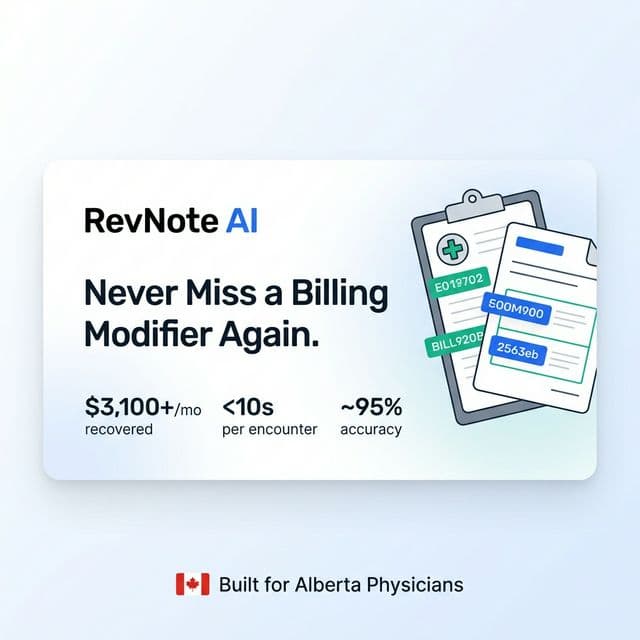
RevNote AI automatically identifies all billable services in your patient encounters and generates documentation that meets Alberta Health audit standards. Our AI specifically recognizes when comprehensive codes like 03.03A, chronic disease codes like 03.07C, and premium codes like 03.04J apply to your clinical work—ensuring you capture every dollar you've earned. Try it free for your first 10 encounters and see exactly how much revenue you've been missing.
No credit card. Works in 60 seconds.