PCPCM vs Fee-for-Service Alberta
— Which Pays More? (2026)
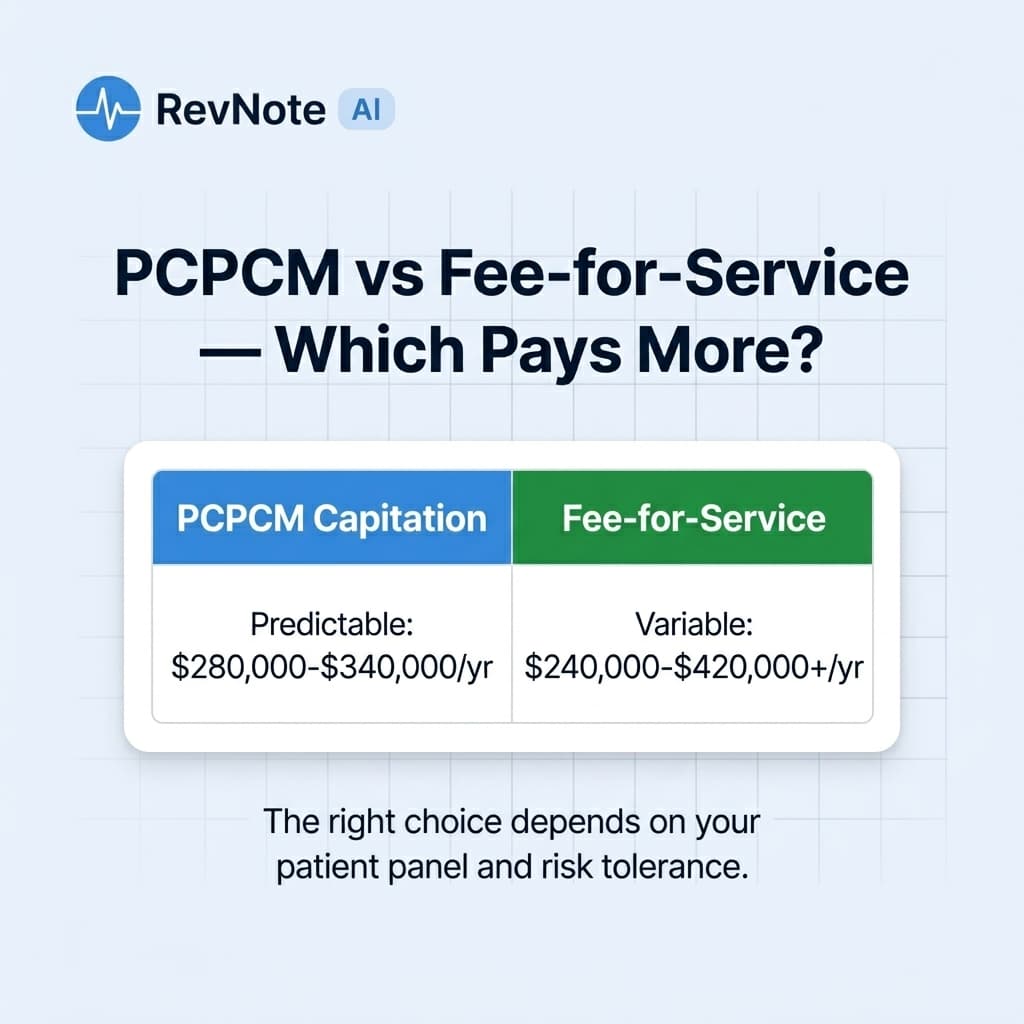
Alberta physicians now have a genuine choice between two compensation models. The answer to "which pays more?" isn't universal — it depends on your patient volume, case complexity, and practice style. This guide has the real math.
What Is PCPCM?
PCPCM (Primary Care Patient's Medical Home) is a blended payment model introduced by Alberta Health Services and the AMA. It replaces or supplements traditional fee-for-service with three income streams:
A fixed annual payment per rostered (attached) patient. Paid regardless of how often you see each patient.
Bonus payments for achieving health indicators: screening rates, chronic disease metrics, immunization rates.
A reduced fee-for-service component that still applies for clinical encounters — with SOMB modifier rules intact.
Head-to-Head Comparison
| Factor | Fee-for-Service | PCPCM |
|---|---|---|
| Income predictability | Variable — tied to patient volume and case mix | High predictability — base payment + panel-based component |
| Revenue ceiling | Uncapped — more complex patients + optimization = more | Partially capped by panel size limits |
| Volume incentive | Direct — more encounters = more revenue | Indirect — quality metrics, not volume, drive bonuses |
| Administrative burden | Full SOMB billing per encounter | Reduced — some components pay automatically by panel |
| Modifier stacking | Full access — 03.05W, 03.05O, 03.63, premiums all apply | Still applies to FFS component of PCPCM |
| Best for | High-volume GP with complex chronic disease patients | GP focused on longitudinal care, lower daily volume |
| Worst for | Physicians who don't optimize modifiers (common mistake) | High-volume walk-in physicians seeing acute undifferentiated cases |
Income Comparison — GP with 25 Patients/Day, 1,500 Panel
230 working days/year. FFS scenario assumes RevNote AI optimization. PCPCM assumes average panel payments and quality incentive achievement.
| Income Component | FFS (Optimized) | PCPCM |
|---|---|---|
| Base encounter revenue | $318,000 | $95,000 (FFS component) |
| Modifier revenue (03.05W, 03.05O etc.) | +$42,000 | +$18,000 |
| Panel/capitation payments | — | +$165,000 |
| Quality incentive bonuses | — | +$28,000 |
| After-hours premiums | +$12,000 | +$5,000 |
| TOTAL | ~$372,000 | ~$311,000 |
| RevNote AI adds | +$42,000 | +$18,000 |
These are illustrative estimates. Actual income varies significantly by practice type, location, patient complexity, PCPCM contract terms, and modifier optimization. Verify current rates with Alberta Health and the AMA.
Which Model Is Right For You?
High-volume walk-in GP (30+ pts/day)
Fee-for-ServiceWith RevNote AI optimization, FFS at 30+ patients/day significantly outperforms PCPCM panel payments. Every modifier captured directly adds to income.
Family physician, stable panel of 1,500+
PCPCM may winFor GPs with a large, established, rostered panel, PCPCM panel payments + quality incentives often match or exceed FFS income — with more predictability and less administrative burden.
Rural/solo GP with lower volume
PCPCM for stabilityPCPCM base payments ensure a floor income regardless of daily volume — critical for rural practices with lower patient density.
Complex chronic disease specialist
Fee-for-ServiceA GP seeing complex patients with 3+ chronic conditions per visit, applying 03.05W ×3, 03.05O, 03.08D, can easily generate $150-$240 per encounter. At this per-visit revenue, FFS wins decisively.
Frequently Asked Questions
What exactly is PCPCM in Alberta?
PCPCM (Primary Care Patient's Medical Home) is a blended compensation model introduced by Alberta Health Services and the Alberta Medical Association. It combines three payment components: (1) a base capitation payment per rostered patient per year, (2) quality incentive payments for meeting specific health indicators, and (3) a reduced fee-for-service component for clinical encounters. It is designed to reward longitudinal, comprehensive care over raw visit volume.
Can I switch between PCPCM and fee-for-service?
Switching between payment models requires formal application and approval through Alberta Health and your Regional Health Authority. There are typically annual enrollment windows. Physicians considering a switch should consult with their provincial medical association representative and review the current enrollment terms carefully before committing.
Does RevNote AI work with PCPCM billing?
Yes — RevNote AI is valuable in both models. PCPCM still has a fee-for-service component where encounter billing applies, and modifier optimization directly increases income from that component. Additionally, accurate and complete clinical documentation supports quality indicator compliance, which drives PCPCM quality bonuses.
What are PCPCM quality incentives based on?
Alberta PCPCM quality incentives are based on indicators such as: cancer screening rates (mammography, colorectal), diabetes management metrics (HbA1c testing frequency), childhood immunization rates, chronic disease management documentation standards, and patient attachment rates. Achieving these metrics generates additional payments on top of base capitation.
Which model is growing in Alberta?
Alberta Health has been actively encouraging PCPCM enrollment as part of a provincial primary care transformation strategy. Enrollment has grown significantly since 2022. However, fee-for-service remains the dominant model by physician count, particularly among urban and walk-in clinic physicians. Both models are expected to coexist long-term.
Related Billing Guides
Maximize Revenue — FFS or PCPCM
RevNote AI finds every modifier in either billing model. FFS physicians capture full modifier revenue. PCPCM physicians optimize their FFS component and support quality indicator documentation. 10 encounters free.
No credit card. 60 seconds to start.