Sessional vs Shadow Billing in Alberta
— Which Pays More? (2026)
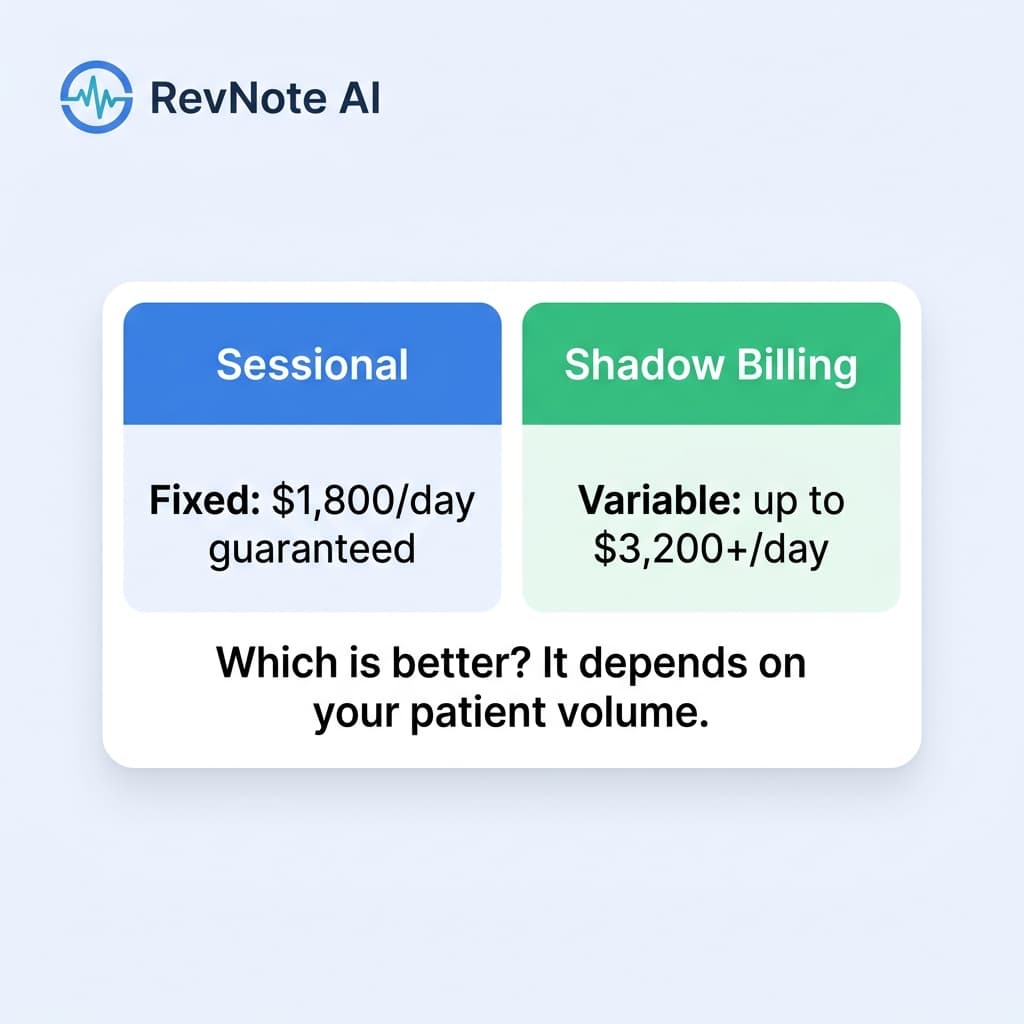
Two very different ways Alberta physicians earn income from hospital and facility work. Sessional billing gives you predictable guaranteed income. Shadow billing (fee-for-service submitted alongside a sessional stipend) gives you a performance ceiling. Which is right for your practice? This guide has the math.
What Is Sessional Billing?
Sessional billing is a compensation model where a physician is paid a fixed rate per session (typically a half-day or full day) by a health authority, hospital, or facility — regardless of how many patients they see or what the fee-for-service equivalent would be.
Common sessional settings in Alberta:
The sessional rate is negotiated directly with the facility or regional health authority. AHS (Alberta Health Services) publishes regional physician compensation frameworks, but rates vary significantly by service type and geography.
What Is Shadow Billing?
Shadow billing means submitting claims to Alberta Health (AHCIP) for services rendered under a sessional arrangement, even though the physician is already paid their sessional stipend by the facility. The physician does NOT receive additional payment from AHCIP — the AHCIP notionally "pays" the facility instead.
Why shadow billing matters even though you don't get extra money:
Alberta Health uses your billing history to calculate future eligibility for various physician incentive programs. Gaps in your billing history from sessional-only periods can affect this.
AHS facilities increasingly require shadow billing as part of sessional contracts. It provides utilization data that supports resource allocation and staffing decisions.
Your shadow billing volume demonstrates the fee-for-service equivalent of your work. A physician generating $3,200/day in shadow claims has strong negotiating leverage for their sessional rate.
Inaccurate shadow billing — just like inaccurate AHCIP billing — can be flagged by Alberta Health's audit systems. Apply the same SOMB accuracy standards to shadow claims.
Head-to-Head Comparison
| Factor | Sessional Billing | Shadow / Fee-for-Service |
|---|---|---|
| Income predictability | High — fixed rate regardless of patient volume | Variable — depends entirely on patient volume and complexity |
| Administrative burden | Low — facility handles billing | Medium-High — you must submit shadow claims accurately |
| Earning ceiling | Capped at agreed sessional rate | Uncapped — more patients = more revenue |
| Risk exposure | Very low — guaranteed income | Higher — slow days or rejections reduce income |
| Best for | Predictable low-volume settings (e.g., nursing homes, rural) | High-volume, complex patient settings (e.g., hospital wards) |
| Revenue at 20 pts/day | Same rate regardless: ~$1,800/day (typical) | ~$2,100-$2,800/day depending on complexity mix |
| Revenue at 8 pts/day | Same rate: ~$1,800/day | ~$900-$1,200/day — sessional wins |
The Break-Even Calculator
At what patient volume does fee-for-service shadow billing outperform your sessional rate?
What to Watch Out For
A sessional rate agreed in 2024 that doesn't escalate with SOMB fee increases loses real value every year. Negotiate an annual adjustment clause tied to Alberta Health fee schedule changes.
Some physicians become lax with shadow billing documentation since 'it doesn't affect my pay.' This is a mistake. Alberta Health audits shadow claims with the same algorithms as AHCIP claims. Inaccurate shadow billing affects your billing history and can trigger audits that spill into your fee-for-service practice.
If you're doing shadow billing, apply the same modifier logic (03.05W, 03.05O, 03.63, etc.) as you would in fee-for-service billing. Your shadow claims should reflect your actual clinical work accurately, and failing to include modifiers under-represents your value to the facility.
Frequently Asked Questions
What is the typical sessional rate for Alberta GPs in 2026?
Sessional rates vary significantly by facility type and region. General ranges: Long-term care / nursing home: $1,200–$1,800/half-day session. Hospital inpatient ward coverage: $1,500–$2,400/session. Rural and remote: rates often higher with additional incentives. Always negotiate based on your specific responsibilities and the facility's budget.
What is shadow billing and why does it matter even if I'm paid sessionally?
Shadow billing means submitting fee-for-service claims to Alberta Health even when you're paid a sessional stipend by a facility. Alberta Health uses shadow billing data for healthcare utilization planning and physician payment modeling. Some facilities require it contractually. While you don't receive additional AHCIP payment, accurate shadow billing protects your billing history and supports future sessional rate negotiations.
Can I do both sessional billing and fee-for-service billing at different facilities?
Yes. Many Alberta GPs have a blended practice — for example, sessional coverage at a nursing home two days per week, and fee-for-service in their own clinic three days per week. Keep meticulous records of which services are under which billing arrangement. You cannot bill AHCIP for services already compensated by a sessional arrangement.
What should I negotiate in a sessional contract?
Key negotiation points: (1) Hourly or daily session rate, (2) Whether on-call is included or separate, (3) Mileage/travel allowance for rural facilities, (4) Overtime when sessions run long, (5) Liability insurance coverage, (6) Shadow billing requirements and who submits them, (7) Annual rate escalation clause tied to SOMB fee changes.
At what patient volume does shadow billing pay more than sessional?
The break-even point depends on your case mix. Using average Alberta GP rates from SOMB 2026: If your average encounter generates $75-$90 in fee-for-service revenue, you break even with a $1,800/day sessional rate at about 20-24 patients per day. Above that volume, fee-for-service is better. Below it, sessional wins.
Related Billing Guides
Maximize Revenue Whether Sessional or FFS
RevNote AI works for both fee-for-service and shadow billing. Same AI, same SOMB accuracy, same modifier detection — applied to whatever billing model you use. 10 encounters free.
No credit card. 60 seconds to start.