SOMB Alberta 2026: What's Changed and What GPs Need to Know
If you're not billing for Specialized Office-based Medical Procedures (SOMB) in Alberta, you're leaving significant revenue on the table. These procedure codes range from $46.38 for simple lesion destruction to over $400 for complex procedures, yet many family physicians either forget to bill them or use incorrect documentation that triggers audit flags and claim denials.
Understanding SOMB Codes: Alberta's Most Underutilized Billing Opportunity
Specialized Office-based Medical Procedures (SOMB) represent a distinct category in the Alberta Schedule of Medical Benefits that reimburses family physicians for in-office procedures beyond standard assessments and consultations. These codes cover everything from dermatological procedures like cryotherapy and lesion excisions to minor surgical interventions that you perform daily in your practice. The critical distinction is that SOMB codes are separate from your visit code—you bill both the appropriate assessment fee AND the procedure code when clinically indicated.
The challenge most Alberta GPs face isn't performing these procedures—it's remembering to bill for them correctly and maintaining the specific documentation standards that Alberta Health Services auditors expect. Unlike assessment codes where clinical notes can be relatively general, SOMB billing requires precise procedural documentation including lesion size, location using anatomical landmarks, technique employed, and specific post-procedure care instructions. Without these elements, even legitimate procedures get flagged during reviews.
What makes SOMB codes particularly valuable is their cumulative impact on your practice revenue. A GP performing just three minor dermatological procedures weekly—entirely routine in most family practices—generates an additional $6,000-$8,000 annually in previously missed billings. When you factor in joint injections, IUD insertions, minor excisions, and other common procedures, the revenue opportunity becomes substantial while simultaneously documenting the true scope and complexity of care you're already providing.
Essential SOMB Billing Codes Every Alberta GP Should Know
Applies when you destroy a single skin lesion using cryotherapy, electrocautery, or chemical destruction in patients presenting with benign lesions like warts, seborrheic keratoses, or skin tags requiring treatment.
Can be billed per lesion treated during the same encounter, but documentation must clearly identify each distinct lesion location. Audit risk increases when billing more than 5 lesions in one visit without detailed charting.
Chart must specify lesion location with anatomical landmark, size in millimeters, destruction method used (liquid nitrogen, electrocautery, etc.), and number of freeze-thaw cycles or duration of treatment.
Billable for simple excision of skin lesions requiring closure by simple suturing in a single layer, typically lesions under 2cm on trunk or extremities where minimal undermining is needed.
Cannot be co-billed with complex excision codes for the same lesion. When multiple lesions are excised, each must be documented separately with distinct anatomical locations.
Record lesion size pre-excision in millimeters, exact anatomical location, excision technique, closure method with number and type of sutures, and whether specimen was sent for pathology with requisition number.
Applies to therapeutic or diagnostic injections into major joints including shoulder, knee, hip, elbow, or ankle for patients with arthritis, bursitis, tendinitis, or other inflammatory conditions requiring intra-articular injection.
No specific billing limits per frequency, but repeated injections within short timeframes may trigger review. Cannot bill separately for the medication or syringe—only the procedure.
Chart note must include joint injected with laterality, indication for injection, medication name and dose, injection approach or technique, patient's pre-injection pain level, and post-injection instructions given.
Billable when you insert any IUD (hormonal or copper) for contraception in appropriate candidates after counseling, whether nulliparous or multiparous patients, as a distinct procedure from the assessment visit.
Includes the insertion procedure only; the device itself is billed separately through AHS or patient pays. Cannot re-bill for same-day IUD removal and insertion—use appropriate combination code.
Document IUD type and serial number, insertion date, uterine sounding depth in centimeters, any complications during insertion, string length left in vagina, and post-insertion counseling provided.
Applies when removing superficial foreign bodies embedded in skin or subcutaneous tissue requiring procedural intervention beyond simple extraction, such as wood splinters, metal fragments, or glass requiring incision or exploration.
Only billable when actual procedural intervention is required; simple splinter removal with tweezers doesn't qualify. Documentation must justify why this was beyond basic first aid.
Chart must describe foreign body type, location with anatomical landmark, depth of penetration, removal technique including any incision or dissection performed, and wound care instructions.
Common Documentation Mistakes That Trigger SOMB Claim Denials
Writing 'removed lesion from back' without specific anatomical landmarks is the most common reason for SOMB excision code denials. Auditors need precise locations like '2cm pigmented lesion from right posterior shoulder, 5cm inferior to acromion' to verify the procedure occurred and wasn't duplicated. Always use anatomical landmarks, laterality, and distance measurements from fixed reference points.
Billing 03.03A for simple excision but failing to document the lesion size before excision leaves auditors unable to verify code appropriateness versus complex excision codes. Measure and record lesion dimensions in millimeters before any local anesthetic is injected, as infiltration distorts tissue and invalidates post-injection measurements.
Some GPs bill only the procedure code without an appropriate assessment code for the same encounter, leaving money on the table and creating incomplete billing records. When a patient presents for a scheduled procedure, you still bill the appropriate visit level (03.03A plus the assessment code) as these represent separate compensable services unless the procedure was performed during a different encounter.
Charting 'knee injection given' without specifying which knee, medication details, or clinical indication results in denials during random audits. Complete documentation requires laterality, specific medication with concentration and volume, anatomical approach, indication with supporting examination findings, and patient response—treat it like any other procedure requiring informed consent and technique notation.
Billing destruction codes for lesions removed during other procedures (like removing a skin tag during a complex excision of an adjacent lesion) constitutes duplicate billing. SOMB codes are for distinct, separate procedures; when a minor procedure is incidental to a larger one at the same anatomical site, only the major procedure is billable unless they're truly independent interventions at different locations.
Real Clinical Example: Maximizing SOMB Revenue Documentation
A 58-year-old patient presents for management of multiple skin concerns: three seborrheic keratoses requiring cryotherapy, one suspicious pigmented lesion requiring excision, and osteoarthritis knee pain requiring therapeutic injection.
Frequently Asked Questions
Can I bill both an assessment code and SOMB procedure code for the same patient visit?
Yes, absolutely. SOMB codes (03.01A through 03.07A series) are procedural fees separate from your assessment codes. When a patient presents and you perform both an assessment and a procedure, you bill both—for example, 03.03C ($41.03) for a focused assessment plus 03.04D ($56.18) for a knee injection equals $97.21 total for that encounter. The assessment covers your evaluation and decision-making; the SOMB code reimburses the technical procedure itself.
How do I bill when I destroy multiple lesions in one visit—do I need modifier codes?
You bill 03.01A ($46.38) for each distinct lesion you treat, up to the number you actually destroy. No special modifiers are required, but your documentation must individually describe each lesion's location, size, and treatment. If you destroy five lesions, you submit five separate line items of 03.01A. The key to avoiding audit flags is ensuring each lesion has a unique anatomical location clearly documented—'left forearm,' 'right temple,' 'upper back midline,' etc.
What's the difference between simple excision (03.03A at $89.71) and complex excision codes, and how do I know which to bill?
Simple excision (03.03A) applies when you excise a lesion requiring only simple closure with sutures in a single layer, typically for smaller lesions on areas without cosmetic concern or tension. Complex excision codes apply when you need layered closure, significant undermining, tissue rearrangement, or the lesion is in a cosmetically sensitive area requiring more extensive technique. The distinction isn't just size—a 1.5cm lesion on the back might be simple, while a 1cm lesion on the nasolabial fold requiring layered closure would be complex. Document your technique details to support whichever code you choose.
If I remove a lesion but don't send it for pathology, can I still bill the excision code?
Yes, you can still bill 03.03A ($89.71) or other excision codes whether or not you submit tissue for pathology. The billing code reimburses the surgical procedure of excision and closure, not the pathology submission. However, from a medicolegal and standard-of-care perspective, most pigmented lesions, changing lesions, or any suspicious findings should go to pathology. Document your clinical reasoning if you choose not to submit tissue—'benign-appearing skin tag, patient declined pathology' protects you more than silent omission.
How long after performing a SOMB procedure can I bill for it, and what happens if I forget to submit the code initially?
Alberta Health Services allows claims submission up to 12 months from the date of service, though best practice is billing within days or weeks while documentation is fresh. If you performed a procedure months ago and forgot to bill the SOMB code, you can still submit it as long as you're within the 12-month window and your chart documentation from that date supports the procedure. Include the actual service date on your claim, not today's date. This is why many GPs are discovering thousands in previously unbilled procedures when they audit their own charts—those fees aren't lost unless more than a year has passed.
Related Billing Guides
Stop Leaving SOMB Revenue Undocumented
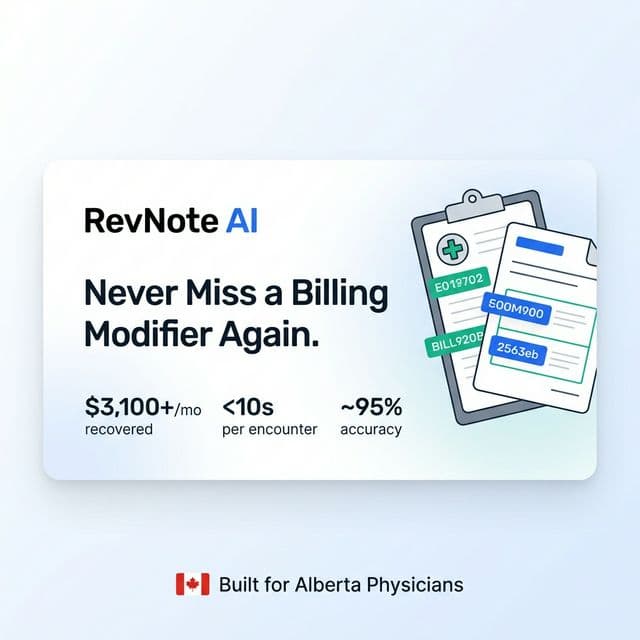
RevNote AI automatically identifies billable SOMB procedures from your clinical documentation and ensures every excision, injection, and destruction is captured with audit-proof chart notes. Our system prompts you for the specific details Alberta Health auditors require—lesion measurements, anatomical landmarks, medication details—so you never miss a billable procedure again. Try RevNote AI free for your first 10 encounters and discover how much SOMB revenue you've been missing.
No credit card. Works in 60 seconds.